Opens in a new tab

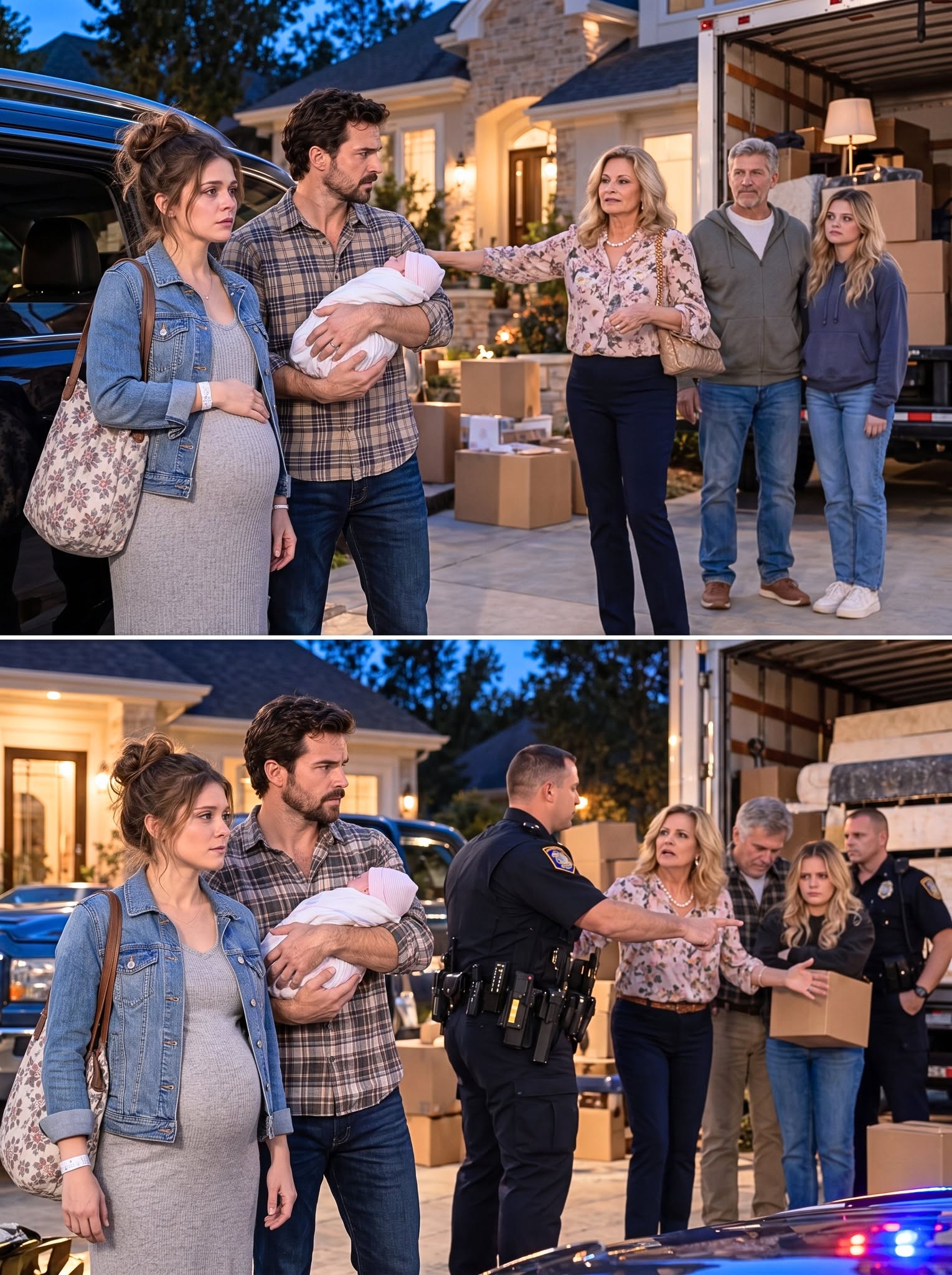
The night I came home with my newborn daughter, I found my mother standing in the driveway beside a moving truck.

P
Press24
October 6, 2026 · 10:51 pm · Andrew Powell

The night I came home with my newborn daughter, I found my mother standing in the driveway beside a moving truck. She smiled and said, “Perfect timing. We’re moving in tonight.” I could barely stand after my C-section, but when her husband picked up a box and headed toward the nursery, I pulled out my phone. “Put that down.” Mom laughed. “And what exactly are you going to do?” Her smile disappeared when I answered, “Call the police.”

Part 1: The Moving Truck in My Driveway

The night I brought my newborn daughter home, I expected nothing more than silence, sleep, and a chance to recover. Instead, my mother was standing in our driveway beside a rented moving truck, smiling as though she had arranged a welcome-home surprise.

I had been awake for almost thirty hours, and every movement hurt after an emergency C-section. My husband, Evan, carried our daughter Lily against his chest while I slowly climbed out of the car and stared at the boxes already stacked beside our garage.

“Mom? What is this?”

Marianne clapped her hands together before announcing that the entire group was moving in that night. Standing behind her were my stepfather Dale, my younger half-sister Brittany, Brittany’s unemployed boyfriend, and their two sons, and for a moment I actually laughed because the alternative was screaming.

“Perfect timing. We’re moving in tonight.”

“No.”

Mom’s smile tightened as she reminded me that we had four bedrooms and insisted that family was supposed to help family. When I told her the best way she could help was by leaving my property, Brittany rolled her eyes and accused me of acting like royalty just because I had given birth.

“Don’t be dramatic, Claire. You have four bedrooms. Family helps family.”

“Then help me by getting off my property.”

Mom ignored my refusal and began assigning bedrooms as though the arrangement had already been approved. She announced that she and Dale would take the guest room while Brittany and the boys occupied the two rooms upstairs, including the nursery Evan and I had prepared for Lily.

Something inside me became completely still when I realized she intended to take my newborn daughter’s room. Mom stepped closer and explained that Dale’s lease had ended and Brittany could no longer afford her apartment, claiming the entire arrangement had already been discussed.

“You discussed it. I said no.”

“You were hormonal.”

Evan adjusted Lily carefully against his chest and made it clear that nobody was moving into our home. Mom barely acknowledged him before dismissing his opinion as interference in what she considered a private issue between mother and daughter.

“Marianne, this isn’t happening.”

“Stay out of mother-daughter business.”

That was when I understood this wasn’t a misunderstanding or an impulsive request for help. My mother genuinely believed she could arrive with six people, occupy our home, and pressure me into surrendering because I was exhausted, recovering from surgery, and too overwhelmed to fight back.

She was still thinking of the twenty-two-year-old version of me who handed over paychecks whenever she cried about bills. For years, she had learned that enough urgency, guilt, and family pressure would eventually make me give her whatever she wanted, but six months earlier, that pattern had finally ended.

Mom had secretly opened a credit card using my old address and somehow listed me as a guarantor, later dismissing the incident as an innocent mistake. After that, I stopped treating her financial behavior as an uncomfortable family problem and began treating her as a genuine legal risk.

I had saved every text she sent me, installed cameras around the exterior of our property, and spoken to an attorney about the credit-card incident. The house she repeatedly referred to as our “family home” was also owned through a trust she had no legal authority to touch, although she knew none of the precautions I had taken.

Mom finally snapped her fingers toward Dale and ordered him to begin with the upstairs bedrooms. He picked up one of the boxes and started toward the house while I reached into my pocket and pulled out my phone.

“Start with the upstairs rooms.”

“Put that down.”

Dale stopped, but Mom only looked amused and asked what I intended to do about it. She still seemed convinced that this was another family argument she could win simply by refusing to take me seriously.

“Claire, seriously. What are you going to do?”

When I raised my phone, her smile widened as she sarcastically asked whether I planned to call my doctor. I glanced at the moving truck and then toward the security camera above our garage, knowing it had recorded my repeated refusal to let any of them enter the house.

“Who are you calling? Your doctor?”

“No. I’m calling the police.”

Mom laughed because she still believed it was an empty threat from the daughter she had spent years training to give in. Then the dispatcher answered, and for the first time since I had pulled into the driveway, my mother’s confidence began to disappear.

Part 2: The Paper Trail She Created

My mother didn’t believe I would actually involve the police until she heard the dispatcher’s voice through my phone. Her expression immediately changed, and the confidence she had carried into my driveway began to crack as she realized I wasn’t bluffing.

“You would call the police on your own mother?”

“I’m calling because six people are attempting to enter my home after being told no.”

Dale immediately put the box back down, but Brittany laughed and announced that calling the police wouldn’t matter because they were already receiving mail at my address. My stomach tightened because Evan and I both understood that this was no longer simply about an unwanted moving truck in the driveway.

“We already get mail here. Mom handled it.”

“What mail?”

Mom shot Brittany a warning look, but the damage had already been done. Brittany casually mentioned bank correspondence and school paperwork before declaring that my house was now their official address, which told me my mother had prepared for this long before that night.

False residency claims could make removing unwanted occupants far more complicated if someone successfully created the appearance that they already lived at the property. I kept my voice calm and asked Mom to show me whatever documentation she had used, knowing that challenging her confidence might make her reveal more than she intended.

“Because if you’re claiming residency, I want to see what you used.”

For a moment, her desire to prove that she had outsmarted me overwhelmed her caution. She opened her purse and produced a folder containing utility statements, change-of-address confirmations, and a typed document labeled as a family occupancy agreement.

At the bottom of that agreement was my name and what was supposed to be my signature. I knew immediately that I had never signed it, but Mom smiled as though the document had finally ended the argument in her favor.

“You agreed months ago.”

I photographed every page without touching the papers, while Evan stood beside me staring at the forged signature. Before starting maternity leave, I had worked as a compliance attorney for a regional bank, so fraud documentation, timestamps, electronic records, IP logs, and preservation requests were familiar territory.

“We have rights now.”

Her confidence told me exactly how little she understood about the position she had put herself in. While we waited for the officers, I quietly sent messages to my attorney, the property manager responsible for the trust that owned the house, and the investigator already examining the earlier credit-card incident involving my mother.

The police arrived twelve minutes later, and Mom immediately transformed herself from an aggressive trespasser into an injured parent. She told the officers that I had invited the family to move in before suddenly changing my mind because childbirth had made me emotional.

“My daughter invited us to live here, then changed her mind because she’s emotional after childbirth.”

One officer examined the occupancy agreement before asking whether the signature at the bottom belonged to me. Mom watched closely as I opened my phone and prepared to show him exactly what had happened before that night.

“No. That is not my signature.”

I pulled up our text conversation from two weeks earlier, in which Mom had announced that everyone would stay with us after Lily was born. My response had explicitly stated that nobody had permission to move into the house, receive mail there, bring belongings onto the property, or enter without our consent.

The officer read the messages twice before turning back toward my mother. Then he asked a question that caused Dale to stare at the pavement and made the entire driveway suddenly quiet.

“Do you have keys to this house?”

Nobody answered until Brittany finally muttered that Mom had made copies. When the officer asked to see them, Dale reluctantly reached into his pocket and produced two house keys.

They were copies of our old keys.

Three months earlier, Evan and I had replaced every exterior lock after the credit-card incident made me reconsider how much access my mother had to our lives. The keys in Dale’s hand could no longer open a single door.

For the first time that night, Mom looked genuinely uncertain. She finally understood that while she had spent months preparing to force her way into my home, I had spent those same months preparing to keep her out.

“You’ll regret humiliating me.”

I met her eyes without raising my voice.

“No, Mom. You’re finally going to regret underestimating me.”

Part 3: The Cost of Forgery

The officers ordered everyone to leave our property and documented the forged occupancy agreement before allowing the moving truck to depart with every box still inside. By the time Evan and I finally carried Lily into the house, I was exhausted and hurting, but at least my daughter’s first night home would belong to us.

My mother wasn’t finished. At 8:10 the next morning, while I sat feeding Lily, she posted online that I had thrown my homeless family onto the street only hours after giving birth, and relatives began calling before we had even finished breakfast.

I refused to defend myself through social media or participate in a family argument built around half the truth. Instead, I forwarded everything to my attorney, and by noon he had sent a factual email containing the relevant texts, security-camera footage, forged occupancy agreement, false address changes, and formal notice that any further attempt to enter our property would result in legal action.

Then the investigator handling the earlier credit-card incident called me with information that changed the situation completely. The forged housing agreement followed the same pattern as the credit application Mom had repeatedly denied creating, so investigators had expanded their review of her financial activity.

They discovered that my personal information had been used three separate times over the previous two years. One account had become delinquent, another had been used to help pay Brittany’s rent, and a third had contributed to the financing of Dale’s truck.

My phone showed fourteen missed calls from Mom before I finally answered the fifteenth. She didn’t apologize or ask how Lily was doing, and instead immediately ordered me to tell investigators that everything had been a misunderstanding.

“Tell them it was a misunderstanding.”

“No.”

“You’re destroying this family.”

“No, Mom. I’m ending the part where destroying me counts as family.”

Her voice changed as she explained what could happen if I refused to cooperate. Dale might lose his truck, Brittany could lose her apartment, and Mom herself could face criminal charges, but she spoke as though those consequences were somehow mine to prevent.

“You forged my signature while I was in the hospital.”

“We needed somewhere to go!”

“And you decided my daughter’s first night home was your opportunity.”

For a moment, neither of us spoke. Then Mom reached for the same sentence she had used throughout my childhood and adulthood whenever guilt was more useful to her than an explanation.

“After everything I’ve done for you.”

I looked down at Lily sleeping peacefully against me and realized those words no longer had any power. Becoming a mother had made something painfully clear: love was supposed to protect your child, not turn sacrifice into a lifelong debt that could be collected whenever convenient.

“That sentence doesn’t work anymore.”

I ended the call, and this time I didn’t answer when she called again. For years, I had been trained to believe that protecting myself was selfish whenever it caused discomfort for someone in my family, but I was finally learning that boundaries were meaningless if they disappeared the moment another person became angry.

The consequences didn’t arrive dramatically or all at once. They came through investigators, attorneys, financial records, and official notices, which somehow made them feel even more permanent because there was no argument Mom could make that would erase the paper trail she had created.

The fraudulent accounts were eventually removed from my credit history. Dale’s truck was repossessed after the financing behind it was challenged, while Brittany lost the apartment Mom had secretly been helping her afford with borrowed money obtained through my information.

My mother ultimately accepted a plea agreement that required restitution, probation, and mandatory counseling related to financial fraud. A no-contact order also prohibited her from coming to my home, finally placing a legal boundary around the property she had once treated as though it belonged to her.

The relatives who had attacked me online became noticeably quieter after receiving my attorney’s factual account of what had happened. Two eventually apologized, while most simply disappeared once defending Mom required acknowledging the forged documents and fraudulent accounts.

I didn’t chase any of them for explanations.

By then, I had stopped worrying about who believed my mother’s version of the story.

My priority was no longer keeping the family together at any cost.

It was making sure Lily never grew up believing that love required her to surrender herself.

Part 4: The House Became Ours Again

Over the following months, life gradually became quieter. My mother’s legal case moved forward without my involvement beyond the documents and statements investigators required, and for the first time, I stopped feeling responsible for rescuing her from consequences she had created herself.

The no-contact order meant she could no longer appear at our house, send Dale to speak for her, or use Brittany as an excuse to force another confrontation. Whenever guilt crept in, I reminded myself that Mom had chosen to forge my signature and use my identity long before I ever chose to involve the police.

Six months after the night of the moving truck, our home finally felt like ours again. There were no unexpected relatives in the driveway, no boxes waiting beside the garage, and no constant fear that someone would decide our spare bedrooms belonged to them simply because we were related.

The upstairs room Mom had assigned to Brittany and her sons became Lily’s playroom instead. Evan and I painted the walls pale green, and he spent an entire weekend building shelves along one side for toys, books, photographs, and all the little things our daughter would accumulate as she grew.

Watching him work made me think about how casually Mom had pointed toward those rooms that first night. She had treated our home like unused space waiting to solve everyone else’s problems, never considering that Evan and I had built our lives there intentionally.

Outside, I planted lavender beneath the front windows. It was a small change, but after months of lawyers, investigators, credit reports, and family arguments, doing something ordinary with my own property felt unexpectedly important.

One warm evening, I sat on the porch with Lily sleeping against my chest while the setting sun turned the windows gold. The driveway where the moving truck had once stood was empty, and the only sounds were insects in the yard and Evan moving quietly inside the house.

Then my phone buzzed.

It was a message from one of my aunts.

“Your mother says she wants another chance someday.”

I read the sentence twice before deleting it. Months earlier, those words would have filled me with anxiety because I would immediately have started wondering what everyone expected me to do, how long I was allowed to remain angry, and whether refusing reconciliation made me a bad daughter.

Now I understood the question differently. Maybe forgiveness would become possible someday, but forgiveness and access were not the same thing, and accepting an apology would never require handing someone another opportunity to violate my boundaries.

Blood didn’t create ownership over my home, my finances, or my decisions. Love didn’t require surrender, and becoming a mother myself had finally taught me how distorted those ideas had become in my own family.

I looked down at Lily and thought about the life I wanted her to have. I never wanted her to believe that saying no to me would make her ungrateful, or that being my daughter meant carrying responsibility for my mistakes.

If she grew up and built a home of her own, I wanted her to know that the front door belonged to her. I wanted her to understand that family should be invited into a life, not entitled to invade it.

That realization changed the way I remembered the night she came home from the hospital. At first, I had thought the important moment was calling the police, but the real turning point had happened several minutes earlier, when my mother ordered Dale to carry that first box toward the house.

For once, I had told him to put it down and meant it.

I had spent most of my adult life believing that keeping peace required me to absorb whatever chaos my mother created. The night Lily came home, I finally understood that sometimes protecting your family means refusing to preserve peace with the people threatening it.

I kissed my daughter’s forehead and listened to the quiet inside our home.

For the first time in my life, nobody outside the family Evan and I had created could decide they belonged there simply because they wanted to.

And nobody else had a key.

Part 5: Nobody Else Had a Key

In the months that followed, I began to understand that removing my mother from the driveway had been the easiest part. The harder work was removing the guilt she had spent years planting in me, because even after the legal consequences began, part of me still instinctively wondered whether I had gone too far.

Whenever that doubt surfaced, I returned to the facts. Mom hadn’t simply asked for help and received an angry response; she had forged my signature, redirected mail to my address, copied old house keys, used my identity for financial accounts, and deliberately chosen the night I returned from surgery with a newborn to force her plan into motion.

The difference mattered because my family had spent years teaching me to judge Mom by her intentions while judging me by the consequences of resisting her. If she lied because she needed money, everyone called her desperate, but if I refused because I needed safety, they called me selfish.

Lily changed the way I saw that pattern. Every time I held her, I found myself asking whether I would ever expect my daughter to sacrifice her credit, marriage, home, or peace simply because I had once raised her, and the answer was so obvious that it made my mother’s favorite argument feel almost absurd.

“After everything I’ve done for you.”

For years, those words had sounded like a debt collector knocking at the door. Now they sounded like evidence of a relationship in which love had repeatedly been turned into leverage.

Evan never pressured me to forgive or reconcile. He simply reminded me that our job was to protect the family inside our house, and gradually I stopped treating that responsibility as something I needed to apologize for.

The legal resolution helped because it removed the ambiguity my relatives had relied upon. My mother had accepted restitution, probation, financial-fraud counseling, and restrictions on contacting our home, which meant the situation could no longer honestly be described as an emotional disagreement between a mother and daughter.

Still, occasional messages reached me through extended family. Some said Mom missed me, others said she wanted to meet Lily, and a few suggested that enough time had passed for everyone to “move forward.”

I never responded.

Moving forward didn’t mean returning to the place where the damage started. It meant building something healthier beyond it.

As Lily grew, the house filled with the ordinary evidence of our new life. Toys appeared in the pale-green playroom, tiny clothes accumulated in laundry baskets, and the shelves Evan built slowly filled with books and framed photographs.

The lavender beneath the front windows began to grow too. Whenever I saw it from the porch, I remembered the moving truck that had occupied the same view on Lily’s first night home and how close my mother had come to turning one of the most vulnerable moments of my life into another surrender.

One evening, I stood in Lily’s nursery while Evan rocked her to sleep. Looking around the room my mother had casually assigned to someone else, I realized that protecting this space had never really been about bedrooms or property.

It was about ending an inheritance.

My mother had taught me that family meant unlimited access, that boundaries were insults, and that saying no was something a daughter eventually had to apologize for. I wanted Lily to inherit something entirely different.

Someday she would grow up, make choices I might dislike, and perhaps build a home of her own. When that happened, I wanted her to know that loving me would never require surrendering her independence to me.

That became the real ending to the night of the moving truck. My mother had arrived believing the house belonged to anyone who could claim the word family loudly enough, while I had finally learned that family wasn’t defined by who demanded entrance.

It was defined by who respected the door.

That night, before going to bed, I checked the lock out of habit and looked once more at the empty driveway. Then I slipped my key into my pocket and turned off the porch light.

For most of my life, somebody else had always believed they deserved a key to whatever I had.

My money. My time. My decisions. My home.

That ended the night Lily came home.

The house was quiet, my daughter was safe, and nobody outside the family Evan and I had chosen could enter unless we invited them.

For the first time, that didn’t feel selfish.

It felt like home.