


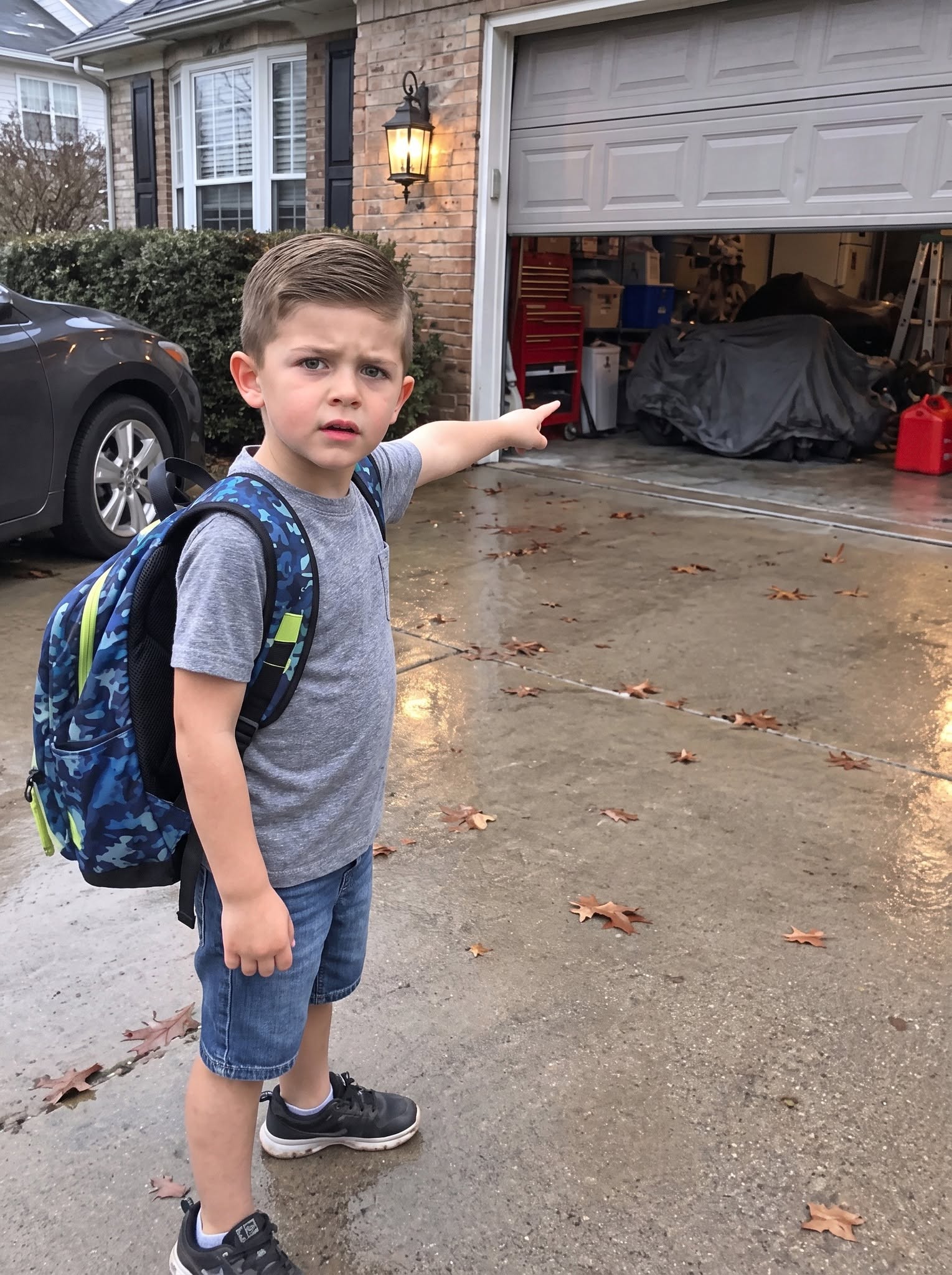
On the way home from kindergarten, my grandson casually told me that his mom and dad had a secret “the police could never find out about.” I laughed at first, assuming it was something harmless. But the more he explained, the less I could breathe. By the time he finished talking, I had already turned the car around and was racing straight to my daughter’s house.
Part 1: The Secret in the Garage
A few afternoons each week, I picked up my five-year-old grandson, Noah, from kindergarten and brought him home with me until his parents finished work. Those drives were some of my favorite moments because Noah could talk endlessly about dinosaurs, playground arguments, lunch boxes, and whichever classmate had cried at recess that day.
That afternoon, however, his voice suddenly dropped to a whisper from the back seat, and he leaned forward as far as his car-seat straps allowed.
“Grandma, I’m going to tell you a secret.”
I smiled at him through the rearview mirror, expecting another story about something that had happened at school.
“Oh?”
“Mom and Dad said even the police can’t know.”
At first, I laughed because Emma and her husband were probably planning some harmless surprise, and Noah had never been particularly talented at keeping secrets. One Christmas, he had revealed the contents of almost every wrapped present before breakfast.
“What are those two doing now?”
His expression remained completely serious as he explained that whatever his parents were hiding was inside the garage.
“What’s in the garage?”
“I’m not supposed to tell you. Dad said nobody can know until it’s ready.”
I assumed it was a birthday present or some unfinished project they didn’t want me to see, but then Noah mentioned hearing Emma ask what they would do if “she” found out. The way he repeated the words made my curiosity sharpen.
“Who is she?”
Noah pointed directly at me.
“You.”
My hands tightened slightly around the steering wheel. Emma had always teased me about turning the smallest suspicious detail into a full investigation before anyone had finished explaining, and perhaps she was right, but now I wanted to know exactly what Noah had seen.
“So tell Grandma what you saw.”
Noah described a red light glowing inside the garage and said he had heard his parents whispering there. He had also watched Emma bring home a package from a flea market, carry it directly into the garage, and warn him not to touch it because whatever was inside wasn’t ready yet.
As I tried to convince myself it was nothing serious, I remembered that Emma had casually asked the previous week whether I still kept belongings from when I was young. By the time I reached the road leading toward my own house, I had already driven past the turn, so I circled back and headed directly toward Emma’s home.
When I pulled into her driveway, I could see a strange red glow through the garage window. I had barely gotten Noah out of the car when Emma opened the back door, and my grandson immediately announced why we were there.
“Grandma came to see the garage.”
“Mom, I was actually going to…”
Before she could finish, I walked past her and entered the garage. Decorative red lights stretched across one wall, illuminating dozens of photographs, some framed and others clipped along pieces of twine, and at first I couldn’t understand why the images made my chest tighten.
Then I recognized the young woman in the photographs as myself, decades younger, sunburned and laughing as though life had never hurt me yet. Relief came first because there was no emergency or crime, and for a moment I assumed Emma had simply created an elaborate display from my past.
Then I noticed a small, dark camera sitting on the workbench beneath the photographs, with a faded sticker still attached crookedly to one side. My hand started toward it before stopping because I knew exactly what I was looking at.
For forty years, I had told people that I lost that camera. I had repeated the explanation so many times that even I had almost stopped questioning whether it was true, but seeing it again made the story I had carefully maintained for decades suddenly feel fragile.
“Where did you get this?”
Emma stepped into the garage behind me before explaining that she had discovered it at a flea market.
“I found it at a flea market.”
The seller had been an older man clearing out belongings after retirement, and Emma remembered hearing me talk about the camera I had lost when I was young. She bought it because she thought returning it would make me happy, but then the man mentioned that undeveloped film was still inside.
“So you developed it.”
Emma nodded, although the excitement she had probably imagined for this moment was already disappearing from her face.
“I thought you’d want to see the photographs.”
I looked back at the wall and asked if she had really developed film from my old camera, printed the photographs, and displayed them without asking me first. Emma explained that I had always sounded sad whenever I mentioned losing it, but my response came out sharper than I intended.
“I said I lost it.”
Emma went quiet, and I realized how much of my past I had spent decades packaging into neat, harmless stories that nobody would question. Now one of those stories had been pulled open and decorated with red lights for everyone to see.
There was only one question that mattered anymore.
“Who sold you the camera?”
Emma hesitated, and that brief pause immediately made me uneasy. When she finally admitted that the seller had become interested after learning the camera might once have belonged to me, I understood that she had kept another detail from me.
“He asked if he could meet you.”
I stared at her.
“And you said yes?”
Emma took a breath before admitting that she had invited the man to dinner because she thought we might have known each other years ago. She awkwardly added that she wasn’t trying to find me a husband, only trying to be my “wingman,” but I was too angry to find the explanation amusing.
“That wasn’t your decision to make.”
I told her she had taken something personal, opened it, displayed it, and invited a stranger into her home without asking me first. Emma’s face reddened, and after glancing toward the kitchen where Noah was humming to himself, she quietly admitted that I was right.
“I should have asked.”
“I don’t want to meet him.”
Before Emma could answer, the doorbell rang.
She opened the door, and an older man stood outside holding a paper bag. His hair had turned silver and time had deepened the lines around his eyes, but forty years were not enough to stop me from recognizing him immediately.
“Stephen.”
His expression changed the instant he saw me.
“Alana.”
In that moment, I understood why seeing the old camera had frightened me.
I had never lost it at all.
Part 2: The Man at the Door
Emma hesitated before admitting that the man who sold her the camera had become interested when she mentioned it might once have belonged to me. He had asked whether he could meet me, and instead of calling me first, she had invited him to dinner.
“You invited some man I’ve never met to dinner because he sold you an old camera?”
“I thought you might actually have known him.”
Emma lowered her voice and explained that she had been thinking about how much of my time I spent looking after everyone else. She thought meeting someone new might be good for me, then quickly insisted she wasn’t trying to find me another husband.
“I was just trying to be your wingman.”
“You decided to play matchmaker with a stranger?”
“I thought you might know him.”
“That wasn’t your decision to make.”
I looked at the photographs covering the garage wall and reminded her that she had developed something deeply personal, displayed it without my permission, and invited the man connected to it into her home before telling me anything. Emma’s face reddened, and after a moment she admitted that she should have asked first.
“I don’t want to meet him.”
The doorbell rang before Emma could respond. She opened the door, and I saw an older man standing outside with a paper bag in his hand, his hair silver and his face marked by four decades I hadn’t witnessed.
None of that mattered. I recognized him immediately.
“Stephen.”
His expression changed as soon as he saw me.
“Alana.”
Forty years disappeared in an instant, along with the tidy version of the past I had spent decades telling everyone, including myself. I folded my arms and reminded Stephen that he still had a remarkable talent for appearing after I had already made up my mind.
He said he had come because he wanted to return something that belonged to me. When I pointed out that he had already sold the camera, he quietly replied that he hadn’t known I would want it back.
“You never understood what I wanted.”
I returned to the garage and began pulling photographs from the wall, but Stephen asked me to stop and look at them in order. Part of me wanted him to leave, yet another part needed to understand why photographs from forty years earlier had suddenly returned to my life.
“Fine.”
Stephen entered but kept his distance, then pointed toward a photograph near the corner. In it, he was leaning toward my old friend Selena, their faces so close that from that single angle, they appeared to be kissing.
My stomach tightened because I remembered exactly what that image had done to me.
“That one.”
“I thought so.”
Stephen told me I was seeing the photograph exactly as I had forty years earlier. I wanted to dismiss him, but the memories had already returned: the humiliation, my anger, Stephen reaching for my hand, and me pulling away before refusing to hear a single explanation.
I had been twenty-five years old and completely convinced that certainty and truth were the same thing. After seeing that photograph, I walked away and left the camera behind, then eventually told everyone I had lost it.
“You never let me explain.”
Stephen pointed toward the next photograph. Selena was laughing while our friend Carl stood beside her with an arm around her shoulders, and the following images showed Stephen among the group as everyone ate, joked, and enjoyed the picnic.
One photograph showed Selena leaning against Carl while Stephen reached across for food. As I continued through the sequence, the supposed betrayal disappeared completely.
It had been an ordinary afternoon among friends. One frozen second had simply made it look like something else.
“You took all these that same day?”
“Most of them.”
Stephen explained that the undeveloped film had remained inside the camera. He had tried to make me see the rest of the photographs forty years earlier, but I had refused.
“You told me never to come after you.”
I opened my mouth to argue, then stopped because I remembered saying exactly that. The humiliating truth was that although I had meant it in my anger, some part of me had expected Stephen to understand that I didn’t truly want him to disappear.
“You could have called.”
“I tried once. You had moved.”
He looked directly at me.
“You made it clear you didn’t want me finding you. Eventually, I decided I had to stop turning your no into a maybe.”
For years, people had joked about how quickly I made decisions, and I had treated it as nothing more than a personality trait. Standing among those photographs, I finally understood that one quick judgment could sometimes shape an entire lifetime.
But I still had no idea that the greatest consequence of that decision was sitting only a few rooms away.
Part 3: The Question Stephen Never Expected
Emma eventually persuaded Stephen and me to leave the garage and sit down for dinner, although the food had already gone cold. For several minutes, the three of us sat around the table without knowing how to begin a conversation that was four decades overdue.
Emma finally broke the silence.
“How long ago did you two know each other?”
Stephen didn’t answer immediately. Instead, he stared at Emma with an intensity that made me uncomfortable, studying her eyes and expressions as though he had suddenly noticed something that had been directly in front of him since he arrived.
“How old are you, Emma?”
She frowned at the unexpected question.
“Forty.”
Stephen became completely still. His gaze moved from Emma to me and then back to her, and I knew immediately what calculation he had just made.
“Alana.”
Something had changed in his voice.
“We broke up forty years ago.”
“I know.”
He took a slow breath, gripping the edge of his chair as though he needed something solid beneath his hand. He told us he didn’t want to assume anything and understood that after all these years, he might not even have the right to ask.
Then he looked directly at Emma.
“But could she be my daughter?”
The room fell silent. Emma stared at me, and in that instant, the secret I had carried alone for forty years no longer belonged only to me.
I had spent decades convincing myself that keeping it buried protected everyone involved. Now, with my daughter waiting for an answer and Stephen sitting across from her, every justification I had once relied upon suddenly sounded much weaker.
“I found out I was pregnant several weeks after I left you.”
The color drained from Stephen’s face.
“I was already pregnant when I walked away.”
His hand slipped from the chair.
“Why didn’t you tell me?”
There was no simple answer that could make what I had done reasonable. I had been angry and proud, convinced that Stephen had betrayed me, and admitting that my judgment might have been wrong had seemed impossible at twenty-five.
“I thought you wouldn’t want to hear from me.”
My voice became quieter as I forced myself to continue.
“I thought you would dismiss everything. But that doesn’t excuse it.”
I looked at Stephen and finally acknowledged the truth I should have faced decades earlier.
“I should have given you the opportunity to decide for yourself.”
Emma had been listening in stunned silence, but now her attention shifted entirely toward me.
“You knew he might be my father?”
“I knew the timing.”
“And you never told me?”
I explained that I hadn’t known whether Stephen would want to be involved in her life. The moment the words left my mouth, however, I heard the flaw in them.
Emma’s expression hardened.
“You decided that for both of us.”
I had no defense because she was right. By refusing to let Stephen explain himself forty years earlier, I had made one decision for him, and by hiding my pregnancy, I had made another decision that belonged to both him and Emma.
For once, I didn’t rush to justify myself or interrupt with an explanation. I remained quiet and allowed my daughter to be angry.
“I need a minute.”
Stephen nodded.
“You don’t have to decide anything right now.”
His voice was gentle, and there was no demand in it.
“I’m not asking you to call me Dad. I just wanted to know.”
Emma studied him for a long time. Stephen had just discovered that he might have a forty-year-old daughter, yet instead of demanding answers or trying to force himself into her life, he waited for her to decide what happened next.
Finally, Emma took a breath.
“I want to have dinner.”
She looked from Stephen to me.
“But I’m asking the questions.”
We returned our attention to the table, although none of us seemed particularly interested in eating anymore. I pulled out a chair for Emma and almost told her where to sit before catching myself.
For forty years, I had made decisions for other people because I believed I knew what was best for them. That evening, for the first time, I understood that loving someone did not give me the right to choose their answers before they had been allowed to ask the questions.
I looked at my daughter and waited.
“Where would you like to begin?”