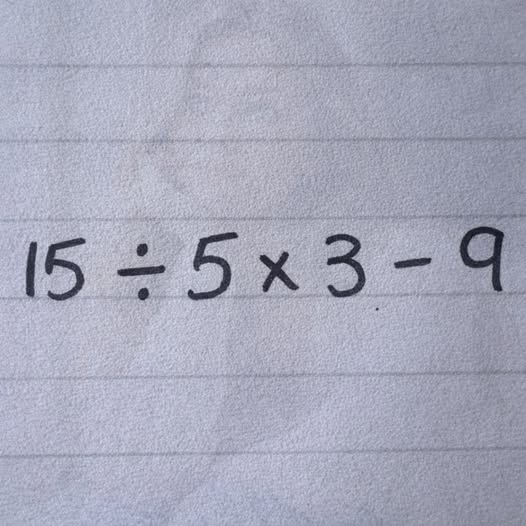
A short expression written on notebook paper—15 ÷ 5 × 3 − 9—looks harmless. Yet it highlights one of the most common points of confusion in everyday math: how to apply the order of operations when division and multiplication appear together.
What the Image Shows
- A single arithmetic expression: 15 ÷ 5 × 3 − 9
- No parentheses, no fraction bar—just division, multiplication, and subtraction in a row
The Name Behind the “Rule”: Order of Operations (PEMDAS/BODMAS)
This problem is really about the Order of Operations, often taught using mnemonics such as:
- PEMDAS: Parentheses, Exponents, Multiplication, Division, Addition, Subtraction
- BODMAS/BIDMAS: Brackets, Orders, Division, Multiplication, Addition, Subtraction
Important clarification: Multiplication and division share the same priority, and so do addition and subtraction. That means you calculate left to right within each priority level.
When It Was “Created” and Who Made It
- Name: The convention is known as the order of operations (mnemonics came later).
- Time of adoption: It evolved over centuries as algebraic notation developed and was later standardized in textbooks to avoid ambiguity.
- Creator: There is no single inventor; it’s a shared mathematical convention refined and adopted by educators and mathematicians over time.
- Purpose (what it’s for): To ensure that an expression like 15 ÷ 5 × 3 − 9 is interpreted the same way by everyone, preventing multiple “correct” answers.
Step-by-Step: The Correct Evaluation
Using the standard order of operations:
- Handle multiplication and division from left to right
- 15 ÷ 5 = 3
- 3 × 3 = 9
- Then handle subtraction
- 9 − 9 = 0
Final Answer: 0
Why People Disagree About This Expression
Confusion usually comes from one (or both) of these issues:
- Mistaking “× before ÷” as a rule
- In reality, × and ÷ are equal priority; you go left to right.
- Treating “15 ÷ 5 × 3” like a hidden fraction
- If someone mentally rewrites it as 15 ÷ (5 × 3), they’ll get a different result—but that introduces parentheses that are not present in the original expression.
How to Make It Unambiguous (Best Practice)
If you’re writing math for others (or for a test), clarity matters. These rewrites remove confusion:
- If you mean left-to-right:
- (15 ÷ 5) × 3 − 9
- If you mean divide by the product:
- 15 ÷ (5 × 3) − 9
- Or use a clear fraction bar:
- 15 / (5 × 3) − 9
Key Takeaway
- Multiplication and division are evaluated left to right.
- For 15 ÷ 5 × 3 − 9, the correct result under standard conventions is 0.