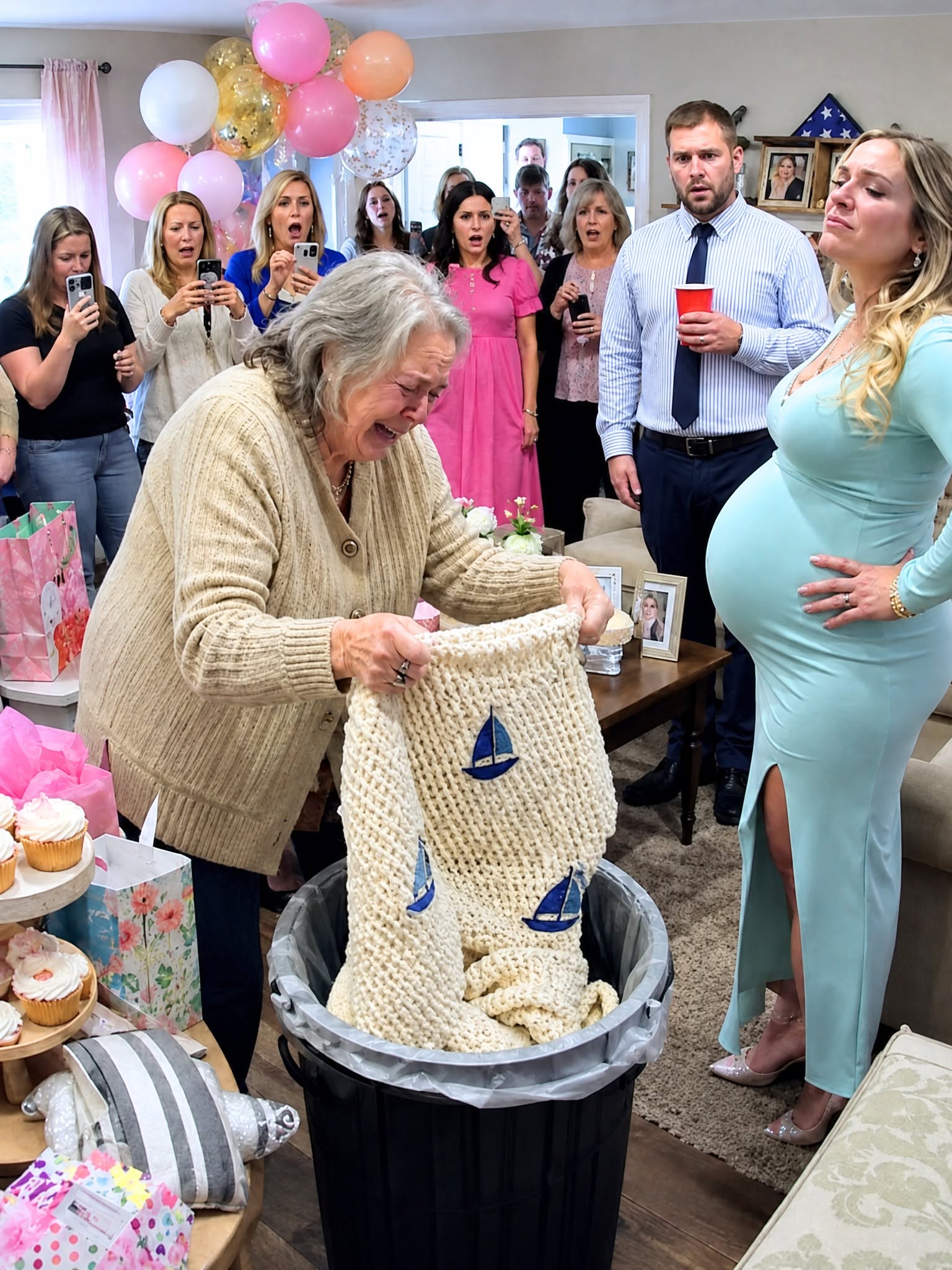
At my grandson’s baby shower, my daughter-in-law tossed the hand-knitted blanket I made into the trash, saying, “We only use designer gifts in this family.” I quietly took it back and went home without a word. That night, my son called with a trembling voice. “Mom… what was hidden inside that blanket?”
Part 1: The Blanket in the Trash
The blanket felt strangely heavier in my lap after Kyle’s phone call than it had when I carried it home from the baby shower. Nothing about the wool had changed, yet suddenly my hands seemed to understand that it held far more than yarn and stitches. I spread it carefully across my knees in the quiet kitchen, smoothing the cream-colored fabric just as I had once laid wedding gowns across my sewing table before beginning my work.
My fingers traced the row of tiny blue sailboats stitched around the border, each one leaning forward as though sailing toward somewhere hopeful. Frank would have loved them. He always admired work that showed patience rather than flash, trusting a straight seam, a repaired hinge, or a carefully saved dollar far more than anything that carried an expensive label.
Madison believed exactly the opposite.
That afternoon, those two completely different ways of seeing the world had collided over a trash bin.
I had known for a long time that my daughter-in-law didn’t particularly like me. She was never openly cruel in the beginning, choosing instead to hide behind polished manners that felt more like a glass wall than genuine kindness. She thanked me for birthday cards without opening them, dismissed my fabric shop as “sweet,” and once asked Kyle, while I stood beside them, whether handmade gifts were “a family thing” or “just your mom’s hobby.”
Kyle had laughed awkwardly, and like so many mothers whose children marry, I swallowed my hurt and let the moment pass. But a baby changes the meaning of small insults, because every gift suddenly becomes part of a child’s future rather than an adult’s pride.
When I arrived at the baby shower, Madison’s mother’s living room looked as though it belonged in the pages of a magazine. Pink and cream balloons floated above perfectly arranged desserts, shiny gift bags lined every table, and every decoration seemed carefully chosen to impress. My gift stood out for all the wrong reasons, wrapped in plain cream paper tied with an old blue ribbon I had saved from my sewing drawer simply because it was too nice to throw away.
As Madison reached for the package, I noticed the brief glance she gave the simple wrapping before she even looked inside. That single expression told me more than words could have, but I still allowed myself to hope. Growing older may teach many lessons, yet somehow it never completely takes away the ability to hope for kindness.
She peeled away the paper and lifted the blanket into the air.
For one brief second, the room became wonderfully quiet. Even people who know nothing about knitting can recognize countless hours of careful work when they see it lying before them.
Then Madison’s expression changed.
She wrinkled her nose ever so slightly while one of her friends continued recording every gift with a phone held high. Holding my blanket delicately between two fingers, Madison turned toward the camera and smiled.
“We only use designer things here.”
Without another thought, she tossed my hand-knitted blanket straight into the trash bin.
Some sounds stay with a person forever, no matter how many years pass. I still remember the soft thud of the wool landing on crumpled tissue paper, followed by the uneasy little laugh that rippled through the room. It wasn’t the laughter of people finding something funny. It was the nervous laughter of people too uncomfortable to defend the woman who had just been humiliated.
I turned toward Kyle.
He stood near the punch bowl clutching a paper cup, his face flushed bright red while his mouth opened once, then closed again without a single word. In that moment, my thirty-eight-year-old son looked less like a grown man and more like the little boy who used to stand quietly in my fabric shop pretending he didn’t need help with his homework.
I could have shouted. I could have told everyone exactly what Madison had thrown away and torn apart the illusion of that perfect afternoon with the truth. Instead, I remembered one of Frank’s favorite lessons: some doors are better opened slowly than kicked in all at once.
So I simply crossed the room, bent down, lifted the blanket from the trash, brushed a piece of tissue paper from its edge, and folded it carefully against my chest. Around me, no one moved. One guest stared into her lemonade as though refusing to choose a side, Madison’s mother suddenly found herself fascinated by the cake knife, and even the friend filming lowered her phone without fully putting it away.
I leaned over and kissed Kyle gently on the cheek. His skin felt warm with embarrassment, and I knew he understood exactly how badly something had gone wrong.
“I’m tired.”
Those were the only words I said before walking quietly out the front door.
The drive home lasted barely twelve minutes, yet grief rode beside me the entire way. Frank had been gone for only ten months, and I still caught myself turning to tell him small things before remembering there was no one sitting in his chair anymore.
He had never cared about luxury. He drove the same truck for nineteen years, saved rubber bands, repaired broken things instead of replacing them, and quietly fixed whatever needed fixing simply because he believed leaving the world a little better was part of being alive. Long before there was even a grandchild to love, he had already begun saving for one. He never called it an investment fund. He simply called it “planting.”
I didn’t discover what he meant until the final week of his life.
Lying in his hospital bed, he asked me to bring him the old cigar box from the top shelf of our closet. I had always assumed it held screws, receipts, or the sort of small objects men keep for reasons they never explain. Instead, I opened it to find stacks of United States savings bonds carefully bundled by year. Resting on top was a large envelope labeled in Frank’s familiar block handwriting.
For our first grandbaby.
Part 2: What Was Hidden Inside the Blanket
I remember sitting down because my knees suddenly refused to hold me. Frank watched my face quietly from his hospital bed before explaining that he had started buying those savings bonds the year Kyle turned ten. Little by little, he set aside overtime pay, birthday money he never spent on himself, work bonuses, and every extra dollar he could spare because he wanted his first grandchild to begin life with something that could never be taken away by bad luck or poor decisions.
The total came to just under fifty thousand dollars. It wasn’t enough to buy mansions or luxury cars, but it was enough to pay for an education, provide security, and give a young person breathing room when life became difficult.
Before he died, Frank made one final request.
He didn’t want me to place the bonds inside an envelope and hand them over during a celebration. He believed money given that way could disappear into expensive strollers, elaborate parties, or anything else designed to impress people for a single afternoon. Instead, he wanted me to sew the bonds into something meaningful so his grandchild would one day discover that real gifts are built from patience rather than appearances.
After Frank’s funeral, I bought soft cream-colored wool and began knitting. Arthritis made every row harder than the last, and there were evenings when I dropped my needles simply because my fingers hurt too much to hold them. Some mornings I couldn’t even close my hands until I soaked them in hot water, but I kept going because every stitch felt like another conversation with the man I had just lost.
I chose blue sailboats for the border because Frank loved the water, even though he always claimed he enjoyed talking to the lake more than catching fish. In one corner, I quietly worked his initials, FM, into the pattern, making them small enough that only someone paying close attention would ever notice. When the blanket was finished, I carefully stitched an almost invisible pocket into the lining, hiding inside it both the savings bonds and a letter Frank had dictated from his hospital bed between long pauses to catch his breath.
His letter wasn’t poetic or dramatic because Frank had never been that kind of man. Instead, he wrote about where our family came from, why labels never measured a person’s worth, and how patience itself could become an expression of love.
On the envelope, I wrote exactly what he had asked me to write.
To be opened when you’re eighteen. Love, Grandpa Frank.
That was the treasure Madison casually tossed into the trash that afternoon.
Remembering all of that, I asked Kyle why he suddenly wanted to know what had been inside the blanket. For several long seconds, he said nothing at all before finally explaining what had happened after I left the baby shower.
Madison’s friend had uploaded the gift-opening video online before anyone thought to stop her. She expected people to admire the elegant decorations, expensive gifts, and beautifully staged party, but viewers noticed something entirely different. They saw Madison smiling as she threw a handmade blanket into the trash, they noticed my trembling hands as I quietly retrieved it, and they watched Kyle standing frozen without defending me.
Someone also noticed something neither Madison nor I had realized during the moment itself. As I lifted the blanket from the trash, the lining shifted slightly, revealing the edge of something hidden inside for less than a second. Kyle replayed the video again and again until he spotted the small embroidered initials in the corner.
Then another memory returned.
He remembered visiting Frank in the hospital shortly before he died. He remembered the old cigar box and how I came home that day with swollen eyes, clutching my purse as though it contained something precious.
Finally, he understood.
“Mom,” he said quietly. “Is it Dad’s?”
I looked down at the blanket resting across my lap. By then, the anger I had carried home from the baby shower had settled into something calmer and far stronger.
“Yes,” I answered. “It is.”
Madison tried to say something in the background, but Kyle stopped her before she could speak. It was the first time I had ever heard my son draw a firm line with his wife instead of smoothing everything over, and that small change told me more than any apology could have.
I walked to my sewing drawer and took out my old silver seam ripper, a tool I had used for decades to undo mistakes one careful stitch at a time. Sliding the point beneath the first thread, I slowly opened the hidden pocket until the envelopes appeared exactly where Frank had left them.
For one overwhelming moment, I cried with relief.
Madison’s insult had wounded me. It had insulted Frank’s memory. But it had not destroyed the gift itself. The bonds remained untouched, and the letter still waited safely for the grandchild it had always been written for.
I told Kyle to come over if he truly wanted to know the rest.
Twenty minutes later, he stepped quietly into my kitchen with uncombed hair and red, exhausted eyes. Madison wasn’t with him, and I was grateful because some conversations deserve honesty without an audience.
I spread the blanket across the table and opened the hidden pocket wider. Kyle noticed the savings bonds before anything else, gripping the back of a chair so tightly that his knuckles turned white. He stared at the envelopes dated year after year before his eyes finally settled on the sealed letter addressed not to him, but to his future child. He reached toward it instinctively, then stopped himself, respecting that it wasn’t his to open.
That single moment of restraint softened something inside me.
When I told him the total was just under fifty thousand dollars, Kyle covered his face with both hands. No parent enjoys realizing that the most valuable gift in the room was the very one their silence allowed someone else to throw away.
I didn’t rush to comfort him.
Sometimes a mother has to let her child sit with the full weight of a painful truth before healing can begin.
Part 3: The Gift That Couldn’t Be Thrown Away
When Kyle finally lowered his hands, his eyes were filled with tears. He didn’t rush through an apology or offer excuses to escape the discomfort. Instead, he quietly admitted he was sorry, speaking with the kind of sincerity that only comes after someone fully understands the damage they allowed to happen.
I told him the money had never been meant for him or Madison. It wasn’t intended for nursery decorations, expensive strollers, or photographs that looked perfect online. Frank had saved every bond for the grandchild who would one day turn eighteen, open that letter, and discover that a grandfather he had never met had been loving him long before he was ever born.
Kyle simply nodded.
He didn’t argue.
At that moment, his phone began vibrating over and over again.
Madison was calling.
He looked at the screen but made no move to answer, and that quiet decision told me something had finally begun to change.
The following morning, Madison came to my house alone. She didn’t bring her mother or the friend who had filmed the baby shower, and when I opened the front door, I noticed that despite her expensive sweater, she looked far less confident than she usually did.
I greeted her politely but didn’t invite her inside.
Some apologies deserve to spend a little time standing outside before they’re welcomed in.
Madison began crying almost immediately. I believed her embarrassment was genuine, but I wasn’t yet convinced it came from true remorse. Those two emotions often look alike, yet they come from very different places.
She tried explaining that she had been overwhelmed, that the party had gotten out of hand, and that she simply hadn’t understood what she was doing. I listened without interrupting before asking the only question that really mattered.
“What exactly did you fail to understand? The blanket? The work? The woman who made it? Or the fact that everyone in that room was expected to laugh simply because you did?”
Madison stood silently for several seconds.
To her credit, she didn’t invent an excuse she couldn’t defend.
Behind her, Kyle remained quietly on the porch without trying to rescue her or soften the moment. That silence meant more to me than anything he could have said.
I told them both that the savings bonds would remain with me, the letter would stay sealed, and the blanket would be carefully protected until their child became old enough to receive it exactly as Frank had intended. If they wanted to fill the nursery with designer brands, that was entirely their decision, but Frank’s final gift would never become another decoration meant to satisfy someone else’s pride.
Madison cried even harder after hearing that. I felt no desire to comfort her because I had learned that rescuing people too quickly often steals the lesson they most need to learn.
Later that day, the video disappeared from the internet, but not before thousands of people had already watched it. Several women who attended the baby shower called to apologize, admitting they should have spoken up instead of remaining silent. Madison’s mother even sent flowers, though I simply placed them on the porch where they could brighten the day without pretending to erase what had happened.
As the weeks passed, Kyle began visiting more often. Sometimes he brought groceries I had never asked for, and other times he simply sat at my kitchen table asking questions about his father that he hadn’t thought to ask in years.
I told him about the ordinary moments instead of the dramatic ones. I described how Frank whistled while sorting the mail, why he always cut Kyle’s sandwiches diagonally because his little boy once insisted they tasted better that way, and how he quietly bought another savings bond during years when we could have used the money ourselves. Those conversations couldn’t erase the humiliation of the baby shower, but they slowly transformed everything that came afterward.
One evening, Kyle asked if he could see the blanket again. I brought it from the cedar chest where I had carefully stored it after sewing the hidden pocket closed once more, and before touching it, he quietly washed his hands without being asked.
That simple gesture made me smile.
He spread the blanket across the table, gently traced the tiny blue sailboats with one finger, and found Frank’s embroidered initials by himself. After standing there in silence for a long time, he folded the blanket exactly the way I had folded it after retrieving it from the trash and held it carefully against his chest.
For the first time since Frank died, I saw a piece of my husband reflected in our son.
Not enough to excuse what happened that day.
But enough to believe those roots had survived.
I still don’t know what kind of mother Madison will become. Shame can sometimes change a person for the better, but it can also teach someone only to hide their worst qualities more carefully. Time will answer that question, just as Frank always believed time rewarded patience better than anything else ever could.
The blanket still rests safely in my home. The savings bonds remain untouched, the letter is still sealed, and one day I will place that cream-colored blanket with its tiny blue sailboats into my grandson’s hands when he is finally old enough to understand the difference between cost and value.
I won’t begin by telling him about Madison or the trash bin.
I’ll begin with Frank.
I’ll tell him about the quiet man who saved a little at a time for a grandchild he might never live to meet, about hands that always repaired things before they broke completely, and about the nearly invisible seam hidden inside that blanket.
When my grandson finally opens it, he won’t simply discover money.
He’ll discover proof that the greatest gifts are stitched together from patience, sacrifice, and a kind of love so steady that not even a trash bin can diminish its worth.