He blamed me for the miscarriage and called me jealous of his pregnant sister. That night I escaped with nothing but blood on my clothes and fear in my lungs. Two years later, he saw me again—and realized I wasn’t the same woman he left behind.
By the time I lost the baby, I was already weak.
My doctor had called it “threatened miscarriage” two weeks earlier. Strict rest. No stress. No stairs. As if you could avoid stress while married to Jason Carter—who measured love by obedience and called it “being realistic.”
That afternoon in our suburban Columbus, Ohio townhouse, I stood at the top of the stairs with a basket of laundry, telling myself I could do one simple thing without asking permission. My hands were damp. My legs felt unsteady. I remember the sound more than the fall—the sharp slap of skin against carpet, the hollow thud as my shoulder hit the wall, the basket tumbling like it wanted to outrun me.
Pain bloomed low in my abdomen.
I crawled to the bathroom and locked the door, but the lock was cheap. Jason slammed his fist into it until the latch gave. His mother, Deborah, pushed in behind him, her face pinched with disgust, as if my body had offended her personally.
When Jason saw the blood on my thighs, his eyes didn’t soften.
They narrowed.
“You did this,” he said, voice rising fast. “You fell on purpose.”
I shook my head, struggling to breathe. “Jason… please… I need the hospital.”
His mother’s mouth curled. “She’s jealous,” Deborah said, almost satisfied. “Natalie’s pregnant and glowing and you can’t stand it.”
Natalie—Jason’s younger sister—was seven months along, the family’s golden miracle. The baby everyone talked about like a trophy.
Jason grabbed my arm so hard I felt my skin pinch. “You never wanted this baby!” he screamed, spittle catching the light. “You wanted it gone!”
“No,” I whispered. “I wanted—”
I didn’t get to finish.
Deborah shoved me down onto the bathroom mat, pinning my shoulders with her weight. Jason’s face twisted, not with grief but with fury, like the loss had insulted him. I remember the sound of his shoes against tile, the jolt of impact against my ribs and hip. I tried to scream, but my throat tightened around panic and pain until only thin air came out.
Somewhere in the chaos, Natalie’s voice floated from the hallway—hesitant, scared. “Jason? Mom? What’s happening?”
“Stay out of it,” Deborah snapped, like she was scolding a dog.
My vision tunneled. The bathroom light buzzed overhead. And in that buzzing, a cold thought formed: If I stay, they’ll kill me and call it an accident.
When Jason finally stepped back, breathing hard, I didn’t argue. I didn’t plead. I went still—so still they mistook it for defeat.
That night, after they went to bed, I wrapped myself in a sweatshirt and shoved my ID, a few bills, and my phone charger into my tote. Blood had soaked through my leggings hours ago; I layered a coat over it, dark enough to hide the stains.
I walked out barefoot to keep the floor from creaking.
Outside, the streetlights made everything look clean and quiet, like violence couldn’t exist in neighborhoods with trimmed lawns. I called an Uber with shaking fingers. When the car arrived, I didn’t look back.
I left in the middle of the night, bleeding—half numb, half furious.
And I promised myself one thing as the house shrank behind us:
He would never touch me again…
I spent the first three months in a shelter in Chicago, hiding behind a name that wasn’t mine.
The physical recovery was grueling, but the mental shift was harder. I had to unlearn the flinch. I had to stop looking for Jason’s shadow in every doorway. I took a job cleaning offices at night, scrubbing floors until my hands bled, saving every cent to put myself through a coding bootcamp. I discovered I was good at logic; it was the only thing in my life that finally made sense.
I changed my hair, my name, and the very way I held my shoulders. I wasn’t just surviving; I was building a fortress.
Two Years Later
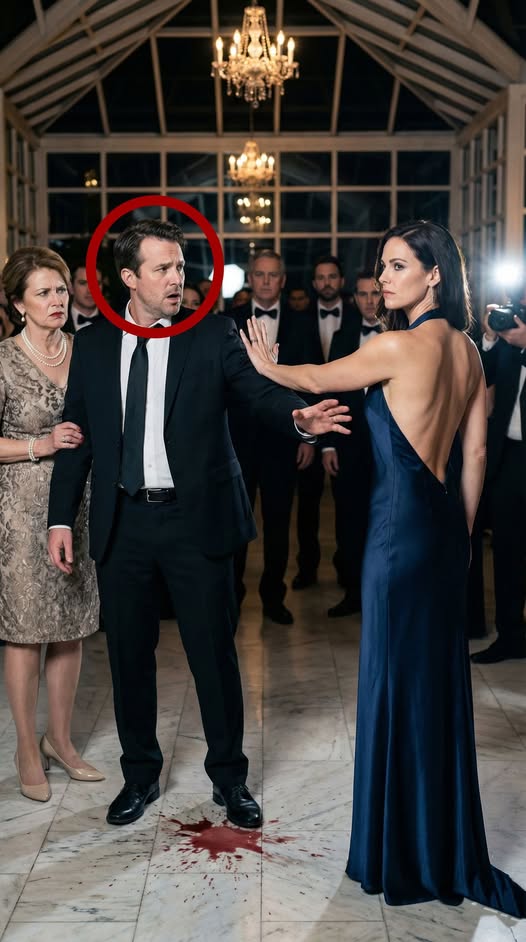
The charity gala for “Women in Tech” was held at the glass-walled atrium of the Hyatt. I was no longer the girl in the blood-stained leggings. I was Elena Vance, the Lead Architect for a firm that was currently being courted for a multi-million dollar acquisition. I wore a backless gown of midnight silk—the scars on my ribs were hidden, but the steel in my gaze was on full display.
Then I saw him.
Jason was standing near the bar, looking slightly older but wearing the same expression of arrogant boredom. Beside him was Deborah, draped in cheap pearls, looking around the room as if she were looking for someone to judge. They were there as guests of a minor donor—small fish in a very large pond.
I didn’t hide. I walked straight toward the bar.
I felt Jason’s eyes lock onto me. I watched the recognition hit him like a physical blow. He dropped his glass, the red wine splattering against the marble floor—a mirror image of the night I left.
“Clara?” he gasped, his voice cracking.
I didn’t flinch. I didn’t even stop walking until I was inches away. “It’s Elena now,” I said, my voice as cool as the ice in my drink.
Deborah stepped forward, her face twisting. “You! You ungrateful little—do you have any idea what you put this family through? Running off like a thief? Jason was a wreck!”
I looked at Deborah, and for the first time in my life, I felt nothing but pity. “I didn’t put you through anything, Deborah. I escaped you. There’s a difference.”
Jason reached out, his hand trembling, trying to grab my arm the way he used to. “You look… you look different. We thought you were dead. You owe me an explanation. You owe me for that baby—”
I caught his wrist before he could touch my skin. My grip was firm, practiced from months of Krav Maga and years of self-reliance. I leaned in close, so close I could smell the stale gin on his breath.
“I don’t owe you anything but a reminder,” I whispered. “I have the medical records from that night. I have the photos of the bruises your mother helped you leave. And unlike two years ago, I have the best legal team in the state on retainer.”
I let go of his arm, and he actually stumbled back. He looked at the room—the CEOs, the photographers, the power I now commanded—and I saw the realization sink in. He couldn’t bully me anymore. I was no longer a person he could own; I was a mountain he couldn’t climb.
“Jason?” A soft voice came from behind him.
It was Natalie. She looked tired. She was holding a toddler, her eyes wide with recognition and a sudden, flickering hope. She looked at me, then at the bruise-like grip Jason still had on his own glass, and then back at me.
I looked Natalie dead in the eye. “It’s never too late to leave, Natalie. The car is always waiting.”
I didn’t wait for her answer. I turned my back on them—the ultimate insult to a man like Jason—and walked toward the stage to give my keynote speech.
As I stood under the bright lights, looking out at a room of people who respected me, I realized I hadn’t just survived that night in Columbus. I had used the fire they tried to burn me with to forge someone unbreakable.
Jason Carter was a ghost from a life I had outgrown. And ghosts can’t hurt you once you stop believing in them.