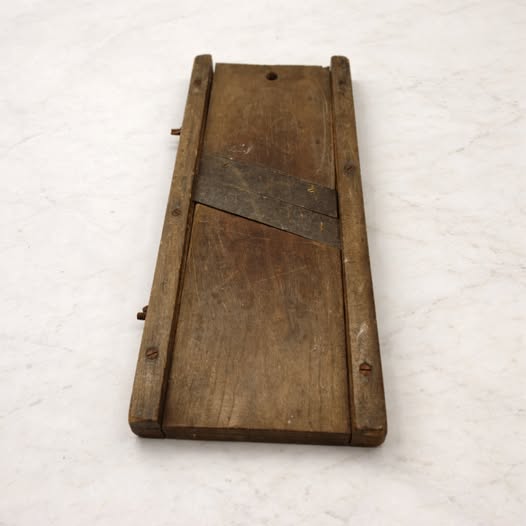
What This Tool Is Called
This antique kitchen implement is commonly known as:
- Wooden Cabbage Cutter / Kraut Cutter
- Cabbage Slaw Slicer / Shredder
- Sauerkraut Slicer
- Sometimes described as a primitive mandoline-style cabbage slicer
Key identifying description from the photos:
- Wooden frame with a slanted cutting opening
- Metal blade(s) set diagonally across the cutting channel
- Round finger/holding hole at one end
- Side screws/clamps that appear designed to secure the slicer to a table or work surface
When It First Appeared
- The style of hand-powered cabbage slicers became widespread in Central and Eastern Europe in the 1700s–1800s, closely tied to home sauerkraut-making traditions.
- The specific “primitive wooden board with fixed blade(s)” form seen here is most commonly associated with late 1800s to early 1900s household and farm kitchens.
- Based on your description, this example is best presented as Early 1900s (circa 1900–1930).
Who Created It
- There is no single known inventor credited with the cabbage slaw/kraut cutter.
- Instead, it is a traditional folk/household tool that evolved over generations in communities where cabbage preservation was a seasonal necessity.
- Many were made by:
- Local carpenters
- Small metalworking shops
- Regional toolmakers
- Or even home-built versions using available wood and a sharpened steel blade
What It Was Used For
The tool was designed for one main job: fast, consistent shredding of cabbage.
Most common uses:
- Sauerkraut preparation: shredding cabbage into thin strips for salting and fermentation
- Coleslaw/slaw: producing uniform slices for fresh salads
- General vegetable slicing: in some homes, it could be used for firmer vegetables (depending on blade spacing and sharpness)
Why it mattered historically:
- Before electric appliances, families needed a way to process large volumes of cabbage quickly during harvest season.
- Uniform slices improved:
- Fermentation consistency
- Texture
- Packing efficiency in crocks or barrels
How It Works (Simple Explanation)
Typical method of use:
- Secure the cutter to a table or board (often using the side screws/clamps).
- Hold a cabbage half or wedge firmly.
- Slide the cabbage back and forth over the diagonal blade opening.
- The blade shaves off thin ribbons that fall onto the table or into a bowl/tub.
Notable functional design elements visible here:
- Diagonal blade placement helps the cabbage “catch” and slice smoothly.
- Raised side rails guide the motion and protect fingers.
- End hole can serve as a grip point or hanging/storage hole.
Why Some Are Called “Two-Blade” Cutters
Depending on the exact build, “two-blade” can mean:
- Two cutting edges/blades mounted in the slicing channel (often parallel or closely spaced)
- Or a single blade assembly that produces multiple cuts through a twin-edge configuration
In practice, the selling term often reflects that the tool was built to increase output per stroke, helping shred cabbage faster than a single-knife setup.
What Makes It “Primitive Farmhouse”
Collectors and decorators value these tools because they show:
- Heavy wear and patina from repeated seasonal use
- Simple materials: wood + steel blade(s)
- Handmade or small-shop construction
- A strong association with self-sufficient farm kitchens and preservation culture
Quick Collector Notes (Optional Talking Points)
- Condition factors that affect value and usability:
- Blade integrity and tightness
- Cracks or splits in the board
- Stability of clamps/screws
- Wood dryness or warping
- Many owners keep them as:
- Wall décor
- Farmhouse kitchen display pieces
- Or as a functional slicer after careful restoration and safe handling