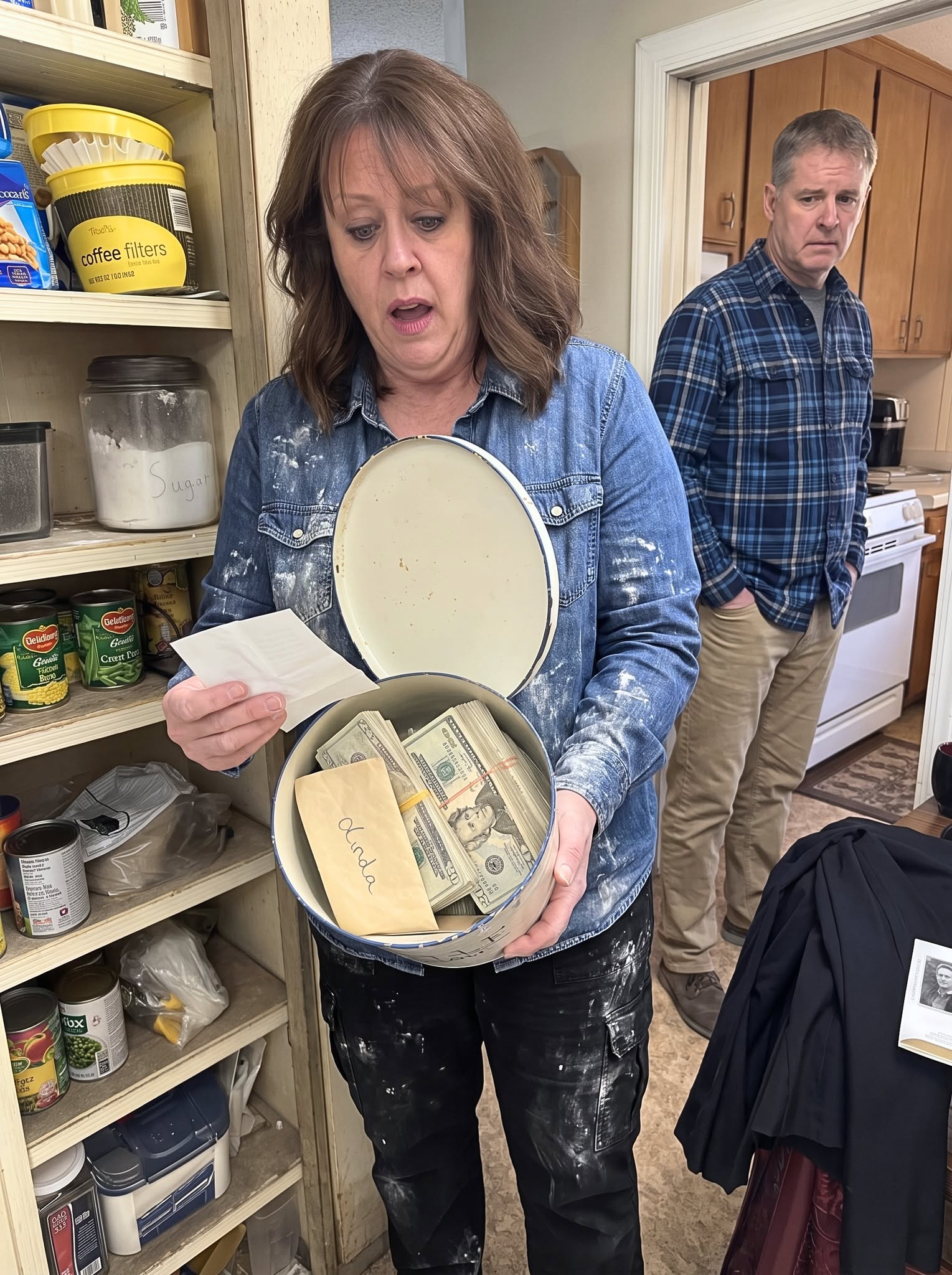
Mama had made an enormous mistake when she discovered what Wayne had done and chose silence instead of telling me the truth. She protected the stability of her marriage rather than fighting for justice for her daughter, but she also spent the next thirty years trying, imperfectly and quietly, to repair that decision.
Russell and I began talking more often after the funeral as well. Several months later, he drove down from Memphis without any particular reason and sat with me at my kitchen table, staring at the same flour tin.
“I should have done more when we were younger.”
“You were twenty-two.”
“Still.”
I looked at him for a moment.
“Still.”
But even that wasn’t the entire truth. Six months after Mama’s funeral, Russell called me one Tuesday evening and finally admitted there was more about Wayne and the settlement that he had never told me.
“I need to tell you the full version.”
Russell explained that Wayne had spoken to him about my settlement before it was even finalized. Russell had actually been twenty-one when Wayne claimed the payout would be smaller than expected because of supposed “legal complications,” using impressive-sounding phrases such as “tax strategy” and “financial restructuring.”
Wayne also instructed him not to discuss the matter with Mama or me because it would only create unnecessary concern. Russell was barely an adult and Wayne was the authority figure in our house, so he believed him.
By the time I turned eighteen and Wayne announced that my money was gone, however, Russell already suspected something wasn’t right. Admitting that suspicion would also have meant confessing that Wayne had previously asked him to keep quiet, so embarrassment and guilt convinced him to say nothing.
Eventually, Russell moved to Memphis, and distance made avoiding the past much easier. But according to him, he had never completely stopped thinking about what happened.
“I thought about it every year.”
“My birthday?”
“Your birthday. Christmas. Everything. I kept telling myself you were okay. You had built a good life.”
“I did build a good life.”
“I know. But that doesn’t make what I did right.”
For once, Russell didn’t defend himself or offer an excuse.
“I’m sorry, Linda.”
We talked for almost an hour about Wayne, Mama, our childhood, and the strange kind of family we had become. We had loved one another, but whenever something painful happened, we learned to hide it rather than discuss it.
Nobody had deliberately taught us to live that way. It simply became the family habit, and over time, silence turned into avoidance, avoidance created distance, and secrets became so normal that they started looking like personality instead of inherited behavior.
In her own deeply imperfect way, Mama had finally broken that pattern. She wrote everything down, collected the evidence, contacted an attorney, entrusted documents to a bank manager, and created a system that guaranteed the truth would eventually reach me even if she couldn’t bring herself to say it while she was alive.
It was decades too late, but it made me determined not to repeat the same pattern with my own daughter. She was twenty-six and living in Atlanta, and during one of our regular Sunday conversations, I finally told her the entire story.
“Do you forgive Grandma?”
I thought carefully before answering.
“I think I understand her more than I forgive her.”
My daughter waited while I searched for the rest of the answer.
“Maybe understanding is where forgiveness begins. So I suppose I’m at the beginning.”
Then she asked another question.
“What do you think Grandma feared most?”
I looked toward the flour tin.
“That I would believe she chose Wayne over me.”
“Did she?”
There was no honest way to soften the answer.
“In that moment, yes.”
My daughter remained quiet while I considered everything Mama had done afterward.
“But everything she did afterward was her trying to choose me.”
That was the hardest truth for me to accept. Mama loved me, and Mama failed me, and those facts didn’t cancel each other out.
For years, I believed I had to choose between seeing her as the mother who betrayed me or the mother who loved me. Eventually, I understood that both women had always been the same person.
I eventually started making Mama’s biscuits again using the old handwritten recipe card I had brought home from her kitchen. I hadn’t made them since childhood because somewhere in my memory, biscuits had become connected to the morning she slapped my hand away from that mysterious flour tin.
One Sunday, I bought a completely new flour container and followed Mama’s recipe. When the biscuits came from the oven, warm and buttery, the smell instantly carried me back to her kitchen.
I could picture Mama protecting that tin, making cocoa afterward, touching my hair, and carrying a truth she wasn’t strong enough to tell me. The old container had somehow become the place where both versions of my mother could exist together: the woman who failed me and the woman who spent thirty years trying to repair that failure.
I invested some of the money we recovered and used another portion to repair my roof. I also took a trip to the Georgia coast with my daughter and donated money to a scholarship fund at my old high school in Mama’s name.
None of those choices were extravagant. They simply felt like a small return of the freedom that should have belonged to me when I was eighteen.
The flour tin still sits empty on my kitchen counter. Some mornings it brings back grief, while on others, looking at that faded blue pattern gives me something closer to peace.
Not because Mama’s choices had somehow become acceptable. They hadn’t.
And not because the past could be repaired completely. It couldn’t.
But I finally understood that the tin had contained much more than $18,940. It held eleven years of five- and ten-dollar bills quietly recovered from Wayne, decades of guilt, fourteen months of careful preparation, legal records, handwritten letters, and one mother’s attempt to reveal a truth she had never found the courage to speak aloud.
One day, that flour tin may belong to my daughter. But unlike Mama, I don’t want my child discovering the most important truths about me after I’m gone.
I want to tell her difficult things while I’m still here. I want Russell and me to have the conversations our family once avoided, and I want our generation to stop turning painful truths into secrets simply because speaking them feels uncomfortable.
I’m not always successful, but I’m trying. Every Sunday, I still make Mama’s biscuits, and little by little, I’m getting better at them.
Maybe that’s what Mama’s flour tin ultimately taught me.
Honesty takes practice.
Forgiveness takes practice.
Families take practice.
And for now, that is enough.