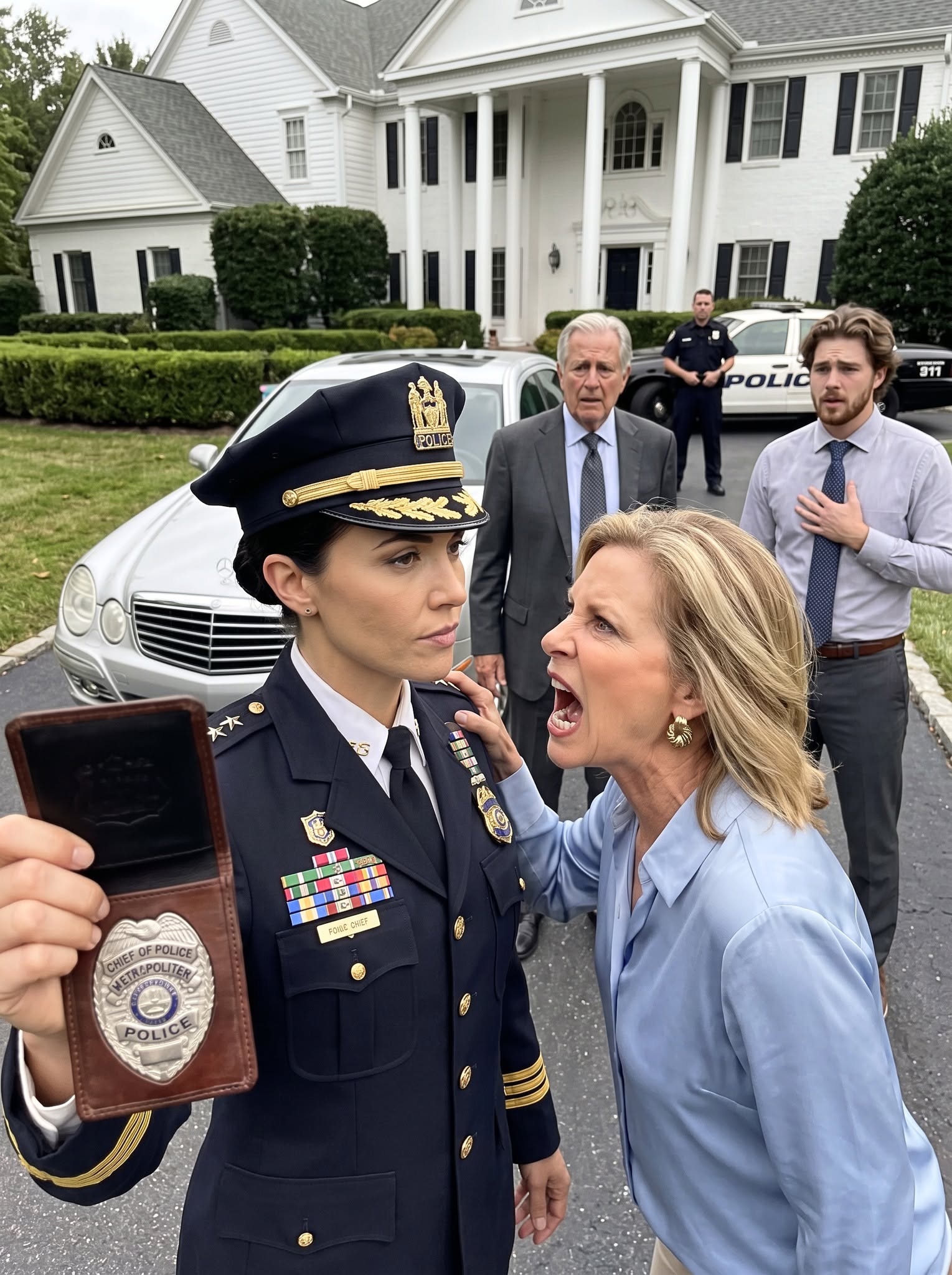
Part 2: The Truth They Never Bothered to Learn
The moment I ended the call, the atmosphere changed completely. My father frowned in confusion, wondering who I had contacted, while I kept my attention on Rafael instead of answering him. I calmly repeated the dispatch request, my voice no longer carrying the tone of a daughter trapped in another family argument but the authority of someone accustomed to issuing orders.
“Send two units to 418 South Rowan.”
“Possible hit-and-run involving a pedestrian.”
“Preserve the truck exactly where it is.”
“Request medical confirmation on the victim and a traffic investigator.”
The patrol car stopped beside the curb almost immediately, and Officers Ben Ortega and Janice Webb stepped out to examine the damaged pickup. The instant Officer Ortega saw me, he stopped walking and spoke a single word that silenced everyone standing in the driveway.
“Chief?”
My mother’s dish towel slipped from her hands, my father’s grip disappeared from my coat, and Rafael stared at the truck as though it might somehow explain what had just happened. My parents had spent years believing I worked an insignificant desk job, never imagining I was the woman every officer in the department answered to.
My father tried to recover first.
“Officer, this is a family matter.”
“There’s been a misunderstanding.”
Officer Ortega ignored the explanation and looked toward me.
“Chief Medina…”
“Are you involved in this incident?”
I answered without hesitation.
“I’m the registered owner of the vehicle.”
“I was not driving.”
“My brother took it without permission.”
“I have a recorded admission.”
“I was inside the house when the collision occurred.”
Rafael immediately denied everything.
“That’s not true.”
I simply held up my phone.
“Your statement has been recorded from the moment my father told me to claim responsibility.”
His expression hardened.
“You recorded your own family?”
“Yes.”
Neither officer reacted to the answer. Ortega accepted my phone, played the recording through the speaker, and quietly listened while my father’s demand echoed across the driveway.
“You’ve got nothing going for you anyway.”
“Just say it was you driving.”
Then Rafael’s voice followed.
“Yeah, I did.”
“And nobody is going to take your word over mine.”
When the recording ended, Ortega looked directly at Rafael.
“Where’s the victim?”
Rafael glanced toward the alley before answering.
“I don’t know.”
“You don’t know?”
“I hit something.”
“Maybe it was a trash bin.”
I looked at him in disbelief.
“That isn’t what you told me.”
He shrugged helplessly.
“I was drunk.”
“I don’t remember.”
Before anyone could say another word, another patrol unit arrived, followed closely by an ambulance. Seconds later, an older man climbed out of a battered blue sedan and hurried toward the officers, shouting before he even reached the driveway.
“She was on the sidewalk!”
“A young woman!”
“Your truck jumped the curb and hit her near the bus stop!”
Every trace of confidence disappeared from Rafael’s face as paramedics rushed toward the intersection. I immediately recognized the location he described and realized something else that neither Rafael nor my parents had considered.
The corner market had a security camera.
The bus shelter had another.
Several nearby homes had doorbell cameras pointed directly toward the street.
There was no version of events capable of hiding what had happened.
There never should have been.
As everyone waited for investigators, I found myself thinking about the life my family had never cared enough to understand. I left home at twenty-one with almost nothing, accepted a records position with the police department, worked my way through every promotion, and eventually became Chief of Police. My parents never attended the ceremony, never asked about my career, and never once wanted to know what I had accomplished.
Instead, Rafael sent me a message two days after my appointment.
“Can you make a speeding ticket disappear?”
That was the only time my position had ever interested him.
My phone vibrated again, interrupting the memory.
Victim conscious. Suspected broken leg. Camera footage being secured.
I quietly read the message twice before slipping the phone back into my pocket. The young woman was alive, and at that moment, that was the only piece of good news anywhere on our street.
Officer Webb began separating everyone for interviews while my father pointed at me in frustration.
“She’s not impartial.”
“She hates her brother.”
I calmly met his eyes.
“I’m not investigating this case.”
“You’re treating him like a criminal.”
“He fled after hitting a pedestrian.”
“He was scared.”
“So was the woman he left lying on the sidewalk.”
Officer Ortega immediately stepped between us as my father tried to move closer. For a brief moment, I almost apologized out of habit, just as I had done throughout my childhood whenever he raised his voice. Then I noticed the fresh red mark on my mother’s wrist where he had shoved past her earlier.
It wasn’t a new pattern.
It was simply one I had finally stopped pretending not to see.